Here’s a question most Indiana homeowners have never thought to ask: if there were a fire in your basement tonight, could everyone get out safely?
It’s not a comfortable question — but it’s an important one. Basements are among the most dangerous areas of a home during a fire. Smoke rises, stairways become impassable quickly, and basement windows in older Indiana homes are often far too small for a person to climb through. That’s exactly why egress window requirements exist, and why they matter far more than most homeowners realize until it’s too late.
At Window Man Inc., we’ve helped hundreds of central Indiana families bring their basement windows up to code. In this post, we’re breaking down exactly what egress window requirements mean, why they protect your family and your investment, and how to know whether your current basement window makes the cut.
What an Egress Window Actually Does
An egress window is a code-required emergency exit built into your home. In a fire or other emergency where the stairway is blocked by smoke or flames, a properly sized and operable egress window gives your family a clear escape path — and gives firefighters a way to get inside quickly.
This isn’t just a building code technicality. House fires move fast. A bedroom with no secondary escape route is one of the most dangerous places to be in a residential fire. In a basement, that danger is compounded: you’re below grade, smoke fills the space quickly, and many older basement windows physically cannot be opened wide enough for an adult to pass through.
An egress window changes that. It’s large enough, operable without tools or keys, and positioned low enough in the wall that anyone — including a child or an elderly person — can use it in an emergency.
Indiana Egress Window Requirements: What the Numbers Actually Mean
Indiana follows the International Residential Code (IRC), which sets the minimum standard for what qualifies as a legal egress window. Here are the four numbers every Indiana homeowner needs to know:
- 5.7 square feet — minimum net clear opening (the actual passable space when the window is fully open)
- 20 inches — minimum opening width
- 24 inches — minimum opening height
- 44 inches — maximum sill height from the finished floor
The most misunderstood number here is the net clear opening. This is not the size of the window frame, not the glass pane measurement, and not the rough opening in your wall. It is the actual usable hole that appears when you open the window completely. A window can look large on the outside and still fail egress if the frame, sash, or operating mechanism cuts the passable space down below 5.7 square feet.
This is one of the most common mistakes homeowners make when shopping for windows themselves: they measure the frame or the glass and assume they’re good. The inspector measures the opening — and those two numbers are almost never the same.
Which Window Types Work Best for Basement Egress
Not all window styles are equal when it comes to meeting egress window requirements. Here’s how the most common types stack up for below-grade installations:
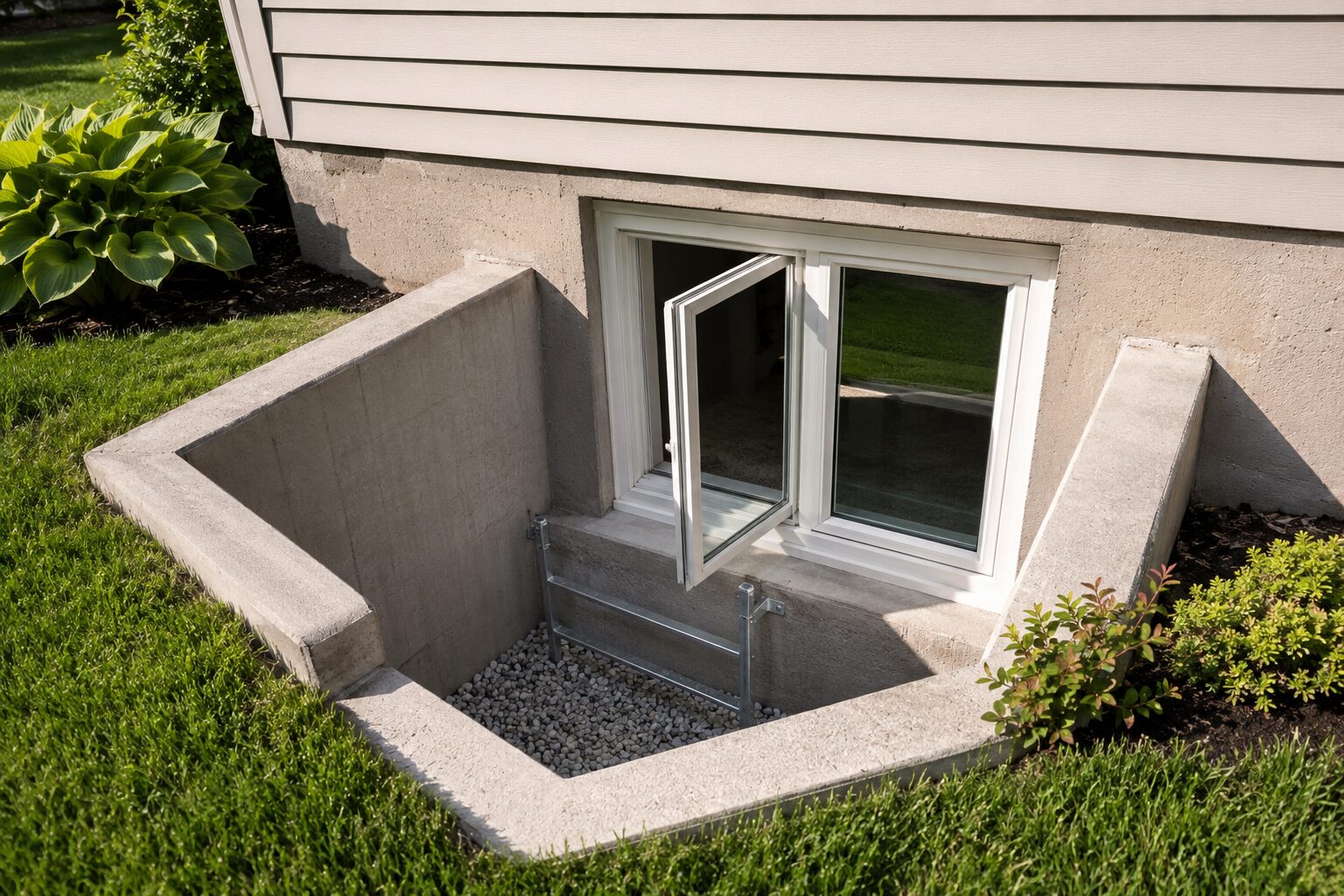
- Casement windows — Our top recommendation. They swing open fully like a door, creating a large unobstructed opening even with a relatively modest frame size. Ideal for tight window wells.
- Sliding windows — A practical option when the rough opening is wide enough. Because only one side opens, you need a larger frame to achieve the required net clear opening.
- Double-hung windows — Common in Indiana homes but rarely the best choice for basement egress. Unless significantly oversized, double-hungs typically can’t achieve 5.7 square feet net clear opening because only half the window opens at a time.
- Awning and hopper windows — Can work in specific situations but require careful measurement and professional sizing to confirm compliance.
For most Indiana basement projects, we recommend casement windows. They offer the best combination of usable opening size, ease of operation in an emergency, and energy efficiency — especially important for below-grade spaces where insulation matters year-round.
When Is an Egress Window Required in Indiana?
Under Indiana’s adopted building code, a basement egress window is required any time a basement space includes a sleeping area — even if you don’t officially call it a “bedroom.” If someone sleeps there, the code applies.
This catches a lot of homeowners off guard. That finished basement with a pullout couch the teenager uses on weekends? Technically requires egress. The “flex room” you’re listing as a fourth bedroom on Zillow? It can’t legally be marketed as a bedroom without one. The basement in-law suite you built for grandma? Definitely requires egress — and likely a properly sized window well configuration, too.
The rule of thumb: if anyone sleeps in your basement, you need a compliant egress window. Full stop.
What About When You Sell Your Home?
This is where egress compliance becomes a financial issue, not just a safety issue. When you list your Indiana home for sale, a buyer’s home inspector will evaluate every basement sleeping space for egress compliance. If your basement “bedroom” doesn’t have a code-compliant window, the inspector will flag it — and your buyer’s lender may require remediation before closing.
At that point, you’re cutting a foundation wall and excavating a window well under sale deadline pressure. That’s a far more stressful and expensive scenario than installing an egress window proactively. Homes with fully compliant basement bedrooms consistently appraise higher and close faster than homes with non-compliant “bonus rooms.”
A compliant egress window protects your family and protects your investment. Both matter.
How to Tell If Your Current Basement Window Qualifies
Here’s a quick self-check. Grab a tape measure, open your existing basement window fully, and measure the actual open space — the hole you could climb through. Your window fails egress requirements if any of the following are true:
- The opening is less than 20 inches wide
- The opening is less than 24 inches tall
- The usable area (width × height) is less than 820 square inches (5.7 sq ft)
- The sill is more than 44 inches from your finished floor
- The window requires a tool or key to open
Most pre-1990s Indiana homes will fail at least one of these tests. Many fail all of them. If you’re not sure, the safest move is a professional evaluation — which Window Man Inc. offers at no cost to central Indiana homeowners.
Schedule Your Free Egress Window Evaluation
Window Man Inc. is a family-owned window installation and repair company based in central Indiana. Egress windows are our specialty, and we’re here to make the process simple, code-compliant, and as affordable as possible for Indiana families.
Whether you’re finishing a basement, listing your home, or simply want peace of mind that your family has a safe exit from every room, we’re ready to help. We’ll assess your existing windows, walk you through your options, and provide a clear, honest quote with no upsells and no surprises.
Call us or submit our contact form today to schedule your free egress window evaluation. Because the best time to make your basement safe is before you ever need it to be.